How to Start Composing
About a month ago I had dinner with a friend, and I was telling him about all this exciting stuff I have planned for Heron Crest, including new pieces, the newsletter, and this blog post. One of the questions on his mind was how does one actually start composing.
I got the impression from him that it felt daunting to begin. It’s easy to feel paralyzed by the high workload and musical training needed that go into a composition.
Now, I don’t want to sound like this great, enlightened figure sitting atop a stack of rocks meditating in front of a great view of the sunsetting horizon. I’m actually the dude about 15 feet away, looking at the same view on a whole different rock, munching on a bag of pork rinds. Very recently in contemplating my publishing efforts, I was discouraged from how many composers are out there and how many great pieces they have written. Yes, here’s my band piece, but why would people play it when they have THAT person’s band pieces?
In truth, there are millions of composers and artists. Here in music we only focus on a select few. In Classical, Mozart was not the only composer in Vienna (“but [he was] the best!”—a fun callback to the film Amadeus). And in Pop music for example, do we see other songwriters get discouraged because they thought they would never be Elton John?
(technically speaking, if they got discouraged enough, we wouldn’t have heard of them, so…)
Thousands of composers have been forgotten, overshadowed, or never broke into the scene over the course of music history. At the same time, new composers and artists are breaking into the scene all the time!
You need three things (well, two to talk about)
OKAY. To write, compose, make new songs, create, collaborate, whatever you want to call it, all you need are three things. Here’s two of them:
An idea, and
to start. In any way you know how.
Notice I didn’t say genius, composition lessons, an action plan, guided assignments, music theory knowledge, a vast library of orchestral scores, piano skills, perfect pitch, a textbook, or notation software. (You do need a pen and paper, though…)
Humble beginnings
In later posts I do plan to go into further detail on how I compose music, and I look forward to attempting to unravel that as each piece is composed differently, yadda yadda yadda. But today I am undeterred in what I believe you need, and to prove it I’m going to share exactly how I began.
To do so, we need to go back to my Get to Know Me post. I mentioned that my dad bought me a blank manuscript book and the rest was history, right? Sure, but I left out a TON of detail just to make the post readable.
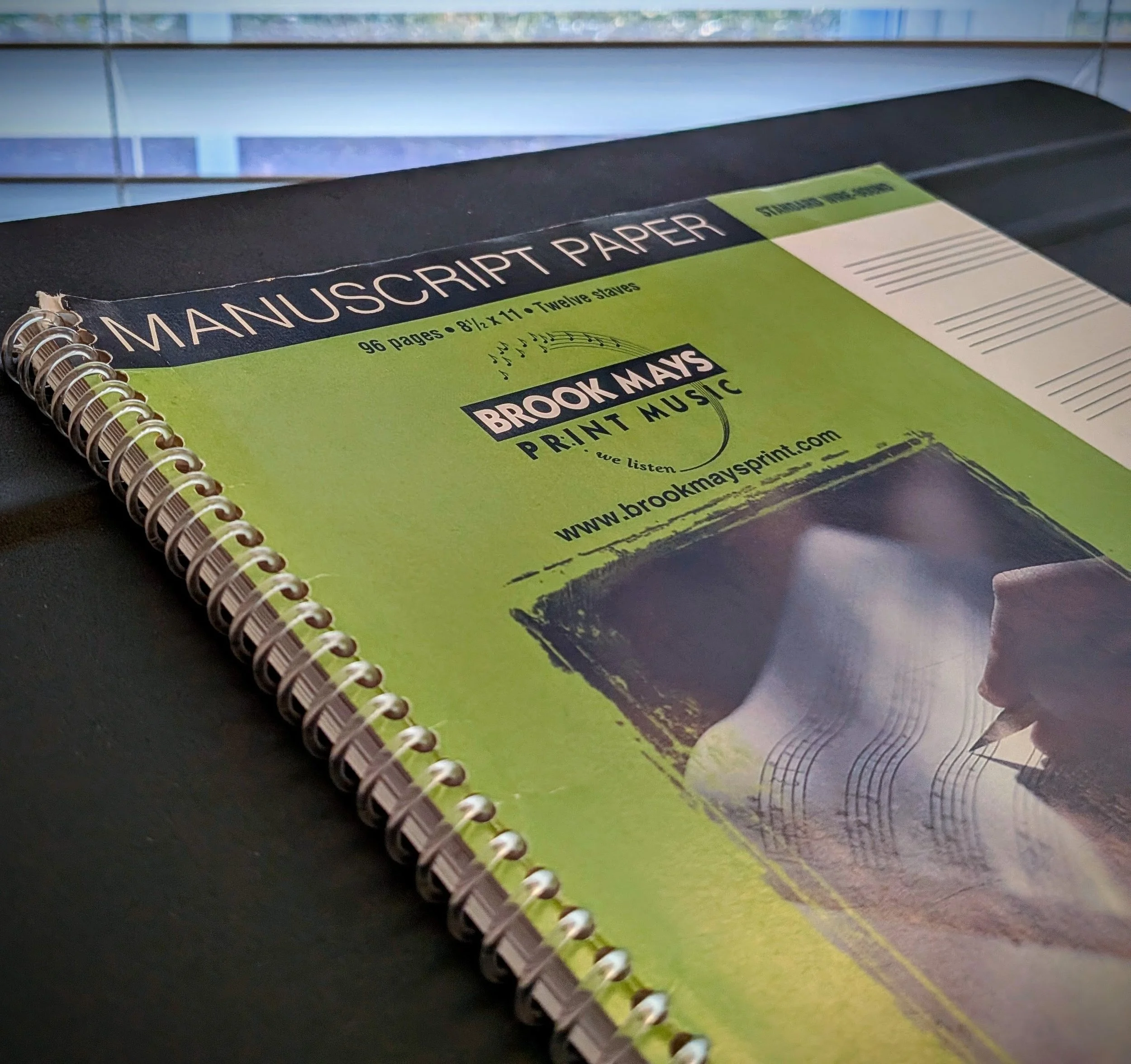
Can’t believe I found it…
The first little “piece” I wrote in that green, coil-bound manuscript book was called Sea Voyage. Remember, I’m not Mozart, so I began in the way I knew how: pencil in my right hand and trombone in my left. I started playing what I thought sounded good on my instrument, and then turning toward my book writing it down on the page.
But what was it like? In brief: scalar, juvenile, and stereotypical. It was full of notation errors and even engineered to “end” when I reached the bottom of the page!
Then the next day I wrote another one. Thunder March!
And maybe a few days later, another one: King of the Gods! (I was thirteen, okay?)
It was fun! I didn’t really know how good of a composer I truly was, but back then it didn’t matter. Eventually I started bringing my notebook when I went to stay with my dad. And one day looking over my shoulder at my notation, he said something off the cuff like “you know, it’d be cool if you wrote a trombone duet and maybe we could play it!” A sweet idea considering that he could no longer play, but that’s how I started writing for a second voice.
See where this is going?
Learning treble clef came from wanting to write for the piano. Instrument transpositions came from trial and error with notation software (THAT was a fun lesson…). I found all these opportunities to write pieces: “jazz” duets for me and a friend to play at a coffee shop, gifts to family and friends, and even a nonet for some friends in high school just to have an excuse to get together and play something I wrote.
Most projects ended with no performance, but a few of them really meant a lot to a few people, and that was enough to keep going.
I didn’t start out with much, but I managed to gather whatever I needed as I went. And the pieces kept coming out, from the juvenile to the ones where I started to have some instruction with. And now to Sunseeker and beyond!
But what’s the third thing you need?
Ah, right. Here’s the third thing: and that is to keep going, in any way you know how. I promise you that you start to pick up the tidbits of knowledge that you eventually need. If you want something bad enough and you seek it out, the universe—or whatever higher power you believe—has a habit of throwing you a bone when you need one. For me, it explains gaining sudden access to notation software, or getting assigned to my first composition lessons with just the right teacher that decided to help me get accepted into the composition department at Indiana.
So where does that leave you? Did you start writing that song or piece you’ve been wanting to put down on paper? Well, I hope you did. Because chances are it didn’t quite turn out the way you had imagined, and that’s okay! The important thing is to write another one. You get better with practice and it trains your brain to find ideas more abundantly.
And down the line, who knows! You might look back on one of your first creations and be inspired to create something even better with it, now armed with all the knowledge you have gained piece by piece.
Now I’m starting to wonder if my compositions played any role in making me more creative with my wordplay…hm.
In any case, happy composing! But more importantly, wear a big grin as you scribble, scratch out, and erase so much that you need to sweep your desk of eraser shavings. Can’t wait to see what you make, and to inspire each other!