Right around the time when I began working at Shutterfly, I was reading a thick book by Harold Schonberg called The Great Pianists. I was on a big piano kick and I wanted to learn about some of the greatest pianists who lived throughout the history of western music. I also thought that with my rather minimal formal training on the piano that I may uncover useful tidbits about piano pedagogy: things like what these great masters believed and how they played.
You’d think that a book chronicling great piano players would be monotonous despite there being 88 different keys to cover, but I was so surprised by how much I couldn’t put it down. In each chapter, which spoke about 3 to 4 masters at a time, I was not only informed by their piano prowess and thoughts on technique, but also their lives: what they thought and how they interacted! It was unbelievably refreshing, and I never viewed these great masters—many of whom I’ve admired for years—like this.
The book was ripe with anecdotes and fun information on who these pianists were as people. Sometimes Schonberg would even give a glimpse of what they did day to day. Because after spending several years putting these people into boxes by studying who they were, what they played or wrote, where they lived, and why they’re important, it’s nice to learn about what they did to be ordinary.
Frederic Chopin
My favorite example of this is one anecdote of Frederic Chopin, 19th-century Romantic pianist who revolutionized piano playing and repertoire. His style and compositional taste were exquisite and deep. Moody, even. Velvety, beautiful, striking; and throughout it all painted with darker colors and tones. He had this sophisticated, non-flashy view of music-making: rarely ever appearing in concert, despite his extreme style and technique. He was one of the greatest and most original pianists to ever live.
But today’s story from Schonberg’s book was of Chopin’s earlier days as a developing pianist, seeking out tutelage from another famous pianist of his day: Friedrich Kalkbrenner.
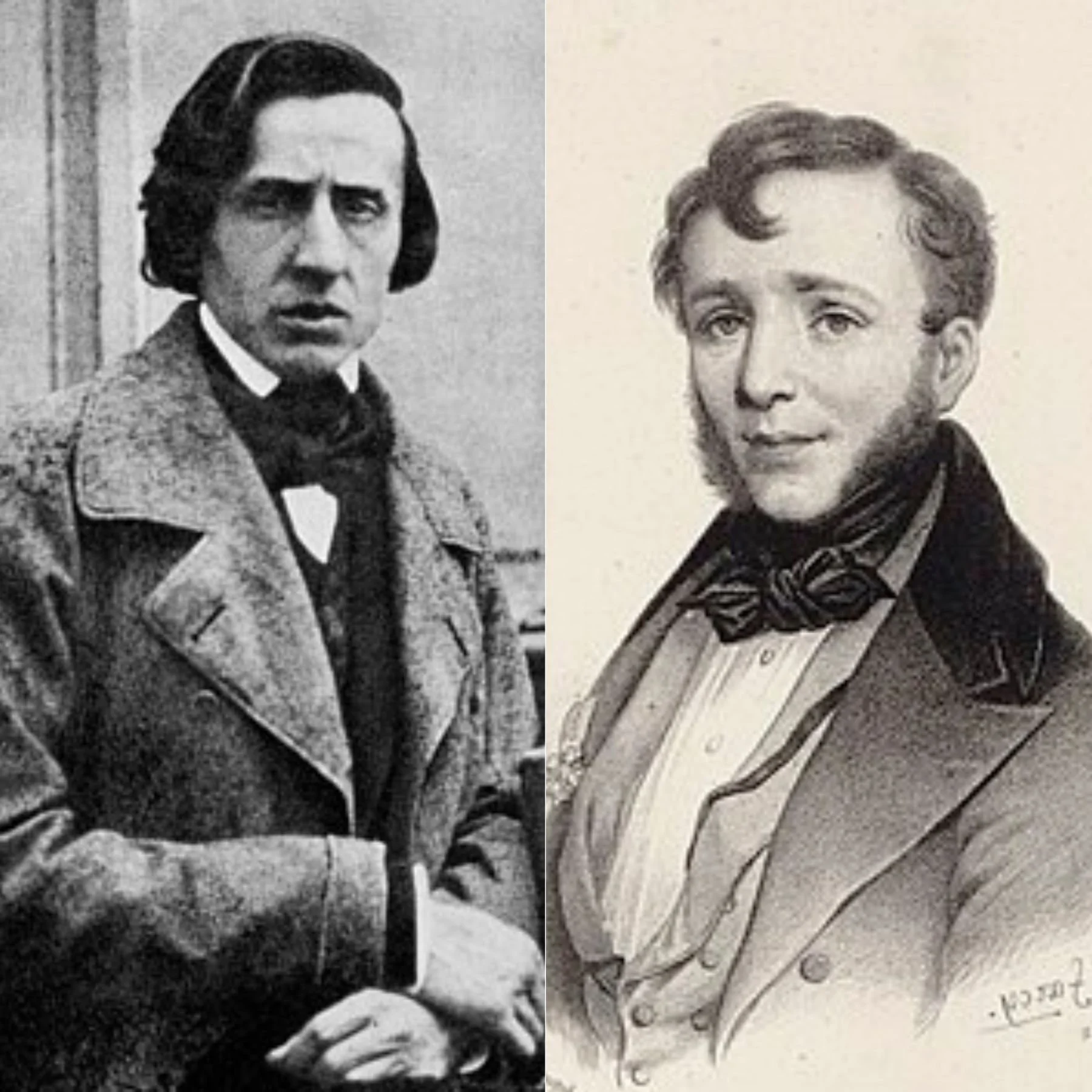
Frederic Chopin (left) and Friedrich Kalkbrenner (right)
Oh boy here we go…
Kalkbrenner wasn’t a bad pianist, in fact according to Schonberg’s research he was a pianist of impeccable accuracy and polish. He wrote a lot of stuff, too. Super successful guy, and he knew it. In life, the man loved his own playing, his own music, his own mind, and his own self. His contemporaries knew it as well, and some of their comments are hilarious to read.
Anyway, Chopin had sought out Kalkbrenner, and Kalkbrenner gave him a piano lesson. The “unfortunately” in this post title comes from Kalkbrenner wanting to revolutionize Chopin’s piano technique, and “finish it off” with the characteristic Kalkbrenner polish. Kalkbrenner saw promise and offered to take him as a pupil for three years to do so.
The story goes that after the lesson Chopin was debating whether to take up Kalkbrenner’s offer. Felix Mendelssohn, who was also a prodigiously gifted pianist and composer himself, knew what Chopin was capable of and gave him the advice he needed, which was more or less: “Pff dude you don’t need Kalkbrenner, you’re amazing! You can play better than him on any day!” With that, Chopin came to his senses, and that was the end of that.
We’ve all been there!
I love this story because it features someone having a bad private lesson, and then a friend having a completely normal reaction to said experience and reassuring him. (because let’s face it: we’ve all had some crazy private lessons, coaches, moments in class, or even just neighbors) It made me feel like I was listening to a story from one of my friends or family members, and not two musicians I’ve come to learn from textbooks and the concert hall.
As I said, I put these great musicians into boxes during my studies. We learned a little or a lot about them, heard some of their music, and compartmentalized them in relation to where they “fit” in the grand scheme of music history. There’s nothing wrong with this; it’s just how we had to learn a lot of information in a very short amount of time.
But these details about composers are often overlooked. I always looked up to Chopin, and I always thought we were very different people. Never in a million years would I have thought that I could relate to him!
Chances are, you’re doing alright
This humanizing element is important, and I think without it, it paints a picture on what we expect our lives and careers to be. The people whom we view to be successful—people who are heroes to us—often have day-to-day interactions we don’t always think about or consider. This goes for people of today and of the past, like Chopin and Kalkbrenner.
And that’s so cool! This can not only teach us performance practice and musical interpretation, but also of simpler lessons like perseverance, grit, and having the ability to encourage others. Because even the greatest musicians are just ordinary people. And ordinary people have feelings, get discouraged, and change their minds!
And that very well may be just what makes them great artists.